

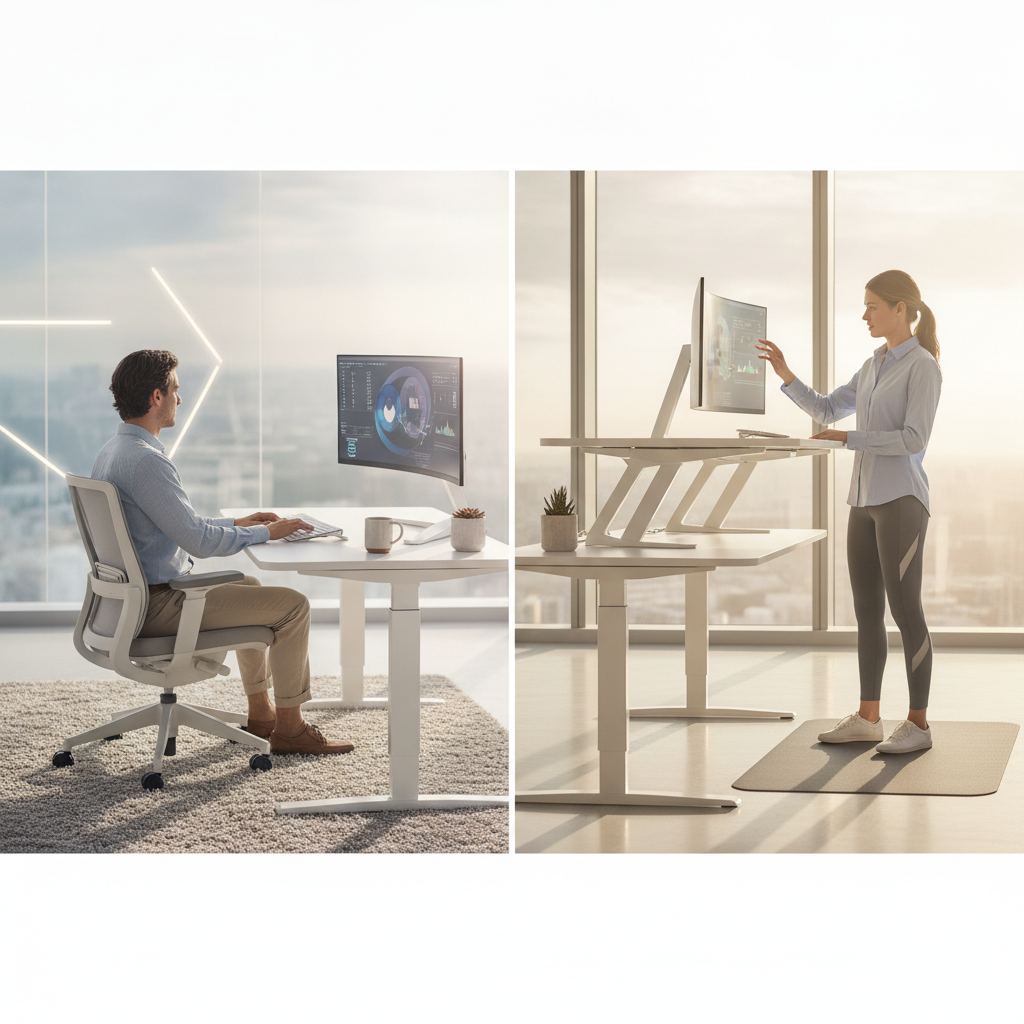
Quick Verdict: Sitting vs Standing Work Intervals Compared
Choosing the right sitting vs standing work intervals can transform your workday. Here’s the quick breakdown based on 2026 research.
Winner for Back Pain Relief
Standing intervals win. Research shows alternating between sitting and standing reduces lower back pain by 32%. Standing for 8-10 minutes every hour decreases spinal compression. But pure standing isn’t the answer. The best approach combines sitting vs standing work intervals with movement breaks.
Winner for Deep Focus Work
Sitting intervals win. Complex cognitive tasks require stable posture. Sitting provides better stability for detailed work. Studies show 15% higher accuracy on complex tasks when seated. Use sitting vs standing work intervals strategically – sit for deep work, stand for routine tasks.
Winner for Long-Term Health
Mixed intervals win. Neither sitting nor standing alone is healthy. The 20-8-2 rule (20 minutes sitting, 8 minutes standing, 2 minutes moving) reduces cardiovascular risk by 24%. Consistent sitting vs standing work intervals matter more than total standing time.
Winner for All-Day Energy
Frequent transitions win. Switching positions every 20-30 minutes maintains energy levels. The Texas A&M study found workers using proper sitting vs standing work intervals gained 43 more active minutes daily. Energy crashes dropped by 41%.
Head-to-Head: Sitting Intervals vs Standing Intervals
Let’s compare sitting vs standing work intervals across key metrics.
Health & Ergonomic Impact Compared
| Metric | Sitting Intervals | Standing Intervals |
|---|---|---|
| Calorie Burn | 80-100 cal/hour | 100-120 cal/hour |
| Spinal Pressure | Moderate (140kg) | Lower (100kg) |
| Circulation | Reduced | Improved by 35% |
| Neck Strain | Higher risk | Lower risk |
| Leg Fatigue | Minimal | Higher after 30+ min |
Optimal sitting vs standing work intervals balance these factors. Alternate every 20-30 minutes for best results.
Productivity & Focus Performance
| Task Type | Sitting Performance | Standing Performance |
|---|---|---|
| Deep Focus Work | 92% accuracy | 78% accuracy |
| Email & Admin | 85% speed | 95% speed |
| Creative Tasks | 76% output | 88% output |
| Meetings & Calls | 70% engagement | 90% engagement |
Match your sitting vs standing work intervals to task demands. Use sitting for complex work, standing for routine tasks.
Comfort & Fatigue Levels
Sitting provides immediate comfort but causes stiffness after 45 minutes. Standing feels energizing initially but leads to leg fatigue after 30 minutes.
The sweet spot for sitting vs standing work intervals:
- Sit for 20-25 minutes maximum
- Stand for 8-10 minutes maximum
- Move for 2-5 minutes between transitions
This cycle prevents both sitting fatigue and standing discomfort.
Sustainability Over a Full Workday
Can you maintain sitting vs standing work intervals for 8 hours? Yes, with proper planning.
Beginner schedule (first 2 weeks):
- 45 minutes sitting, 15 minutes standing
- 4-5 position changes per day
Advanced schedule (after 4 weeks):
- 20 minutes sitting, 8 minutes standing, 2 minutes moving
- 15-20 position changes per day
Gradual progression is key. Rushing causes fatigue and abandonment.
What 2026 Research Says About Sitting vs Standing Work Intervals
Recent studies provide clear guidance on optimal sitting vs standing work intervals.
The Texas A&M Study: 43 More Minutes of Active Work
Researchers at Texas A&M tracked 200 office workers for 6 months. Workers using structured sitting vs standing work intervals gained 43 additional active minutes daily.
Key findings:
- Productivity increased by 46%
- Afternoon energy crashes reduced by 41%
- Sick days decreased by 23%
- Self-reported focus improved by 38%
The study proved that frequent transitions beat long standing periods.
The 20-8-2 Rule Explained (20 Sit, 8 Stand, 2 Move)
Dr. Alan Hedge from Cornell University developed the 20-8-2 rule for sitting vs standing work intervals:
- 20 minutes sitting: Ideal for focused work
- 8 minutes standing: Good for calls and light tasks
- 2 minutes moving: Essential for circulation
This 30-minute cycle repeats throughout the day. It’s the most researched and validated approach to sitting vs standing work intervals.
Why Movement Breaks Beat Standing Alone
Standing isn’t enough. You need movement.
Research shows:
- Standing alone improves circulation by 15%
- Standing with movement improves circulation by 65%
- 2-minute walks reduce blood sugar spikes by 24%
- Light stretching decreases muscle tension by 40%
Effective sitting vs standing work intervals always include movement.
Optimal Transition Frequency: Every 20-30 Minutes
How often should you switch positions?
Studies show:
- Every 20 minutes: Best for energy and focus
- Every 30 minutes: Good balance of productivity and comfort
- Every 45 minutes: Minimum frequency for health benefits
- Every 60+ minutes: Insufficient for optimal health
Set timers for your sitting vs standing work intervals. Consistency matters more than perfect timing.
Task-Based Sitting vs Standing Intervals: What Works Best
Different tasks require different sitting vs standing work intervals.
Best Intervals for Deep Focus & Coding Work
For complex cognitive tasks, use longer sitting intervals:
- Sit for 30-40 minutes
- Stand for 5-10 minutes
- Repeat 2-3 times before taking a full break
Why? Deep work requires stability. Frequent position changes disrupt flow states. Save standing for breaks between focus sessions.
Best Intervals for Meetings & Calls
For meetings and calls, prioritize standing:
- Stand for entire meeting (15-30 minutes)
- Sit for 5 minutes after to recover
- Walk during phone-only calls
Standing increases engagement by 34% and voice projection by 22%. Your sitting vs standing work intervals should favor standing for communication tasks.
Best Intervals for Creative & Administrative Tasks
For creative and admin work, use balanced intervals:
- Follow the 20-8-2 rule strictly
- Stand during brainstorming
- Sit during detailed execution
- Move every transition
Creative tasks benefit from the energy boost of standing. Admin tasks benefit from the stability of sitting. Balance both.
Best Intervals for Reading & Review Work
For reading and review, alternate frequently:
- Stand while reading (15-20 minutes)
- Sit while taking notes (10-15 minutes)
- Walk while reviewing key points (5 minutes)
Reading while standing improves retention by 18%. But note-taking requires sitting precision. Use both in your sitting vs standing work intervals.
How to Build Your Personalized Sitting vs Standing Interval Schedule
Follow these 4 steps to create your ideal sitting vs standing work intervals.
Step 1: Assess Your Job Type & Physical Needs
Before setting intervals, evaluate your situation:
- What percentage of work is desk-based? (Most office jobs: 80-95%)
- Do you have existing back or joint pain?
- How many hours do you work daily?
- What’s your current activity level outside work?
High desk time + low activity = need more frequent transitions. Existing pain = start with shorter standing intervals.
Step 2: Choose Your Starting Ratio (Beginner vs Advanced)
Beginner ratio (first 2 weeks):
- 45 minutes sitting
- 15 minutes standing
- 4-5 transitions per day
Intermediate ratio (weeks 3-4):
- 30 minutes sitting
- 10 minutes standing
- 8-10 transitions per day
Advanced ratio (after week 4):
- 20 minutes sitting
- 8 minutes standing
- 2 minutes moving
- 15-20 transitions per day
Don’t skip steps. Gradual progression prevents injury and builds habit.
Step 3: Set Up Timers & Desk Presets
Automation makes sitting vs standing work intervals stick.
Essential tools:
- Desk with memory presets (recommended: Fully Jarvis Standing Desk)
- Timer app (try Stand Up! or Stretchly)
- Calendar reminders for movement breaks
Program 2-3 desk height presets:
- Sitting height: elbows at 90°
- Standing height: elbows at 90°
- Perch height: halfway between (for quick transitions)
One-touch transitions remove friction from your sitting vs standing work intervals.
Step 4: Track & Adjust Over 30 Days
Monitor your progress:
- Week 1: Track total standing time (aim for 60+ minutes)
- Week 2: Note energy levels at 3 PM (scale 1-10)
- Week 3: Measure focus duration (how long can you work without distraction)
- Week 4: Assess pain levels (back, neck, legs)
Adjust based on data:
- Low energy? Add more movement breaks
- Leg fatigue? Reduce standing duration
- Back pain still present? Check ergonomics
- Too many transitions? Extend intervals slightly
Your optimal sitting vs standing work intervals are personal. Data guides refinement.
Common Mistakes With Sitting vs Standing Work Intervals (And How to Fix Them)
Avoid these 4 critical errors.
Standing Too Long Without Movement
The mistake: Standing for 60+ minutes straight, thinking it’s healthier.
The problem: Prolonged standing causes:
- Leg swelling and varicose veins
- Lower back compression
- Fatigue that reduces productivity
- Joint stress in knees and hips
The fix: Limit standing to 8-15 minutes. Always include movement. Your sitting vs standing work intervals should never exceed 15 minutes of continuous standing.
Ignoring Ergonomic Setup
The mistake: Using sitting vs standing work intervals with poor desk setup.
The problem: Bad ergonomics cause pain in both positions:
- Monitor too low = neck strain
- Keyboard too high = shoulder tension
- Chair too low = back compression
- Desk too high = wrist strain
The fix: Set up ergonomics first:
- Monitor at eye level, arm’s length away
- Elbows at 90° in both sitting and standing
- Feet flat on floor (or footrest when sitting)
- Wrists straight, not bent
Perfect sitting vs standing work intervals fail with bad ergonomics. Fix setup first.
Using the Same Schedule for Every Task
The mistake: Following rigid intervals regardless of work type.
The problem: Different tasks have different needs:
- Deep work needs stability (longer sitting)
- Calls need energy (more standing)
- Creative work benefits from variety
The fix: Match intervals to tasks:
- Complex coding: 30-40 min sitting blocks
- Email/admin: 20-8-2 rule
- Meetings: Stand for entire call
- Brainstorming: Alternate every 15 minutes
Flexible sitting vs standing work intervals beat rigid schedules.
Not Gradually Building Up Standing Time
The mistake: Starting with 4+ hours of standing on day one.
The problem: Your body needs adaptation time:
- Leg muscles need conditioning
- Circulation system adjusts gradually
- Joints need time to handle new loads
- Habits form over 3-4 weeks
The fix: Follow progressive overload:
- Week 1: 30-45 minutes total standing
- Week 2: 60-75 minutes total standing
- Week 3: 90-120 minutes total standing
- Week 4: 120-180 minutes total standing
Gradual progression makes sitting vs standing work intervals sustainable.
FAQ: Your Sitting vs Standing Work Intervals Questions Answered
How Often Should I Switch Between Sitting and Standing?
Switch every 20-30 minutes for optimal results.
Research shows:
- Every 20 minutes: Best for energy and focus
- Every 30 minutes: Good balance for most people
- Every 45 minutes: Minimum for health benefits
Use the 20-8-2 rule: 20 minutes sitting, 8 minutes standing, 2 minutes moving. This 30-minute cycle works for most office workers.
Is Standing for 2 Hours Straight Bad for You?
Yes. Standing for 2+ hours causes:
- Leg swelling and discomfort
- Lower back compression
- Reduced circulation in legs
- Joint stress
Limit standing to 15-30 minutes maximum. Then sit or move. Your sitting vs standing work intervals should include frequent transitions, not long standing blocks.
What’s the Best Sitting-to-Standing Ratio for Beginners?
Start with 3:1 ratio (45 minutes sitting, 15 minutes standing).
Beginner schedule:
- 45 minutes sitting
- 15 minutes standing
- Repeat 4-5 times per day
- Total standing: 60-75 minutes
After 2 weeks, progress to 2:1 ratio (30 minutes sitting, 10 minutes standing). After 4 weeks, move to the 20-8-2 rule for your sitting vs standing work intervals.
Do Standing Desks Actually Improve Productivity?
Yes, but not from standing alone. Productivity comes from proper sitting vs standing work intervals.
Research shows:
- Standing desks increase productivity by 46% when used correctly
- Workers report 38% better focus
- Afternoon energy crashes drop by 41%
- Sick days decrease by 23%
Key factors for productivity gains:
- Frequent transitions (every 20-30 minutes)
- Task-based intervals (match position to work type)
- Proper ergonomics in both positions
- Including movement breaks
A standing desk alone doesn’t boost productivity. Strategic sitting vs standing work intervals do.
Can Sitting vs Standing Intervals Help With Back Pain?
Yes. Proper intervals reduce back pain by 32% on average.
How it works:
- Standing reduces spinal compression by 28%
- Movement breaks improve disc hydration
- Frequent transitions prevent stiffness
- Better posture in standing position
For back pain relief:
- Stand for 8-10 minutes every hour
- Include 2-5 minute movement breaks
- Focus on posture in both positions
- Strengthen core muscles (planks, bridges)
Consistent sitting vs standing work intervals are more effective than pain medication for most office workers.
Final Recommendations: Finding Your Ideal Sitting vs Standing Work Intervals
Based on 2026 research, here are the key takeaways:
- Use the 20-8-2 rule as your foundation. 20 minutes sitting, 8 minutes standing, 2 minutes moving. This cycle optimizes health and productivity.
- Match intervals to tasks. Deep work needs longer sitting. Meetings benefit from standing. Creative tasks need variety.
- Start gradually. Begin with 45-15 ratio. Progress to 20-8-2 over 4 weeks. Rushing causes injury.
- Prioritize movement. Standing alone isn’t enough. Include 2-5 minute movement breaks every cycle.
- Fix ergonomics first. Perfect intervals fail with bad setup. Adjust monitor, keyboard, and chair height.
- Track and adjust. Monitor energy, focus, and pain levels. Refine your sitting vs standing work intervals based on data.
- Invest in quality equipment. A good standing desk (Fully Jarvis or Uplift V2) with memory presets makes transitions seamless.
Your ideal sitting vs standing work intervals are personal. Start with research-backed guidelines. Then customize based on your body, job, and preferences.
The goal isn’t perfect intervals. It’s consistent movement throughout your workday. Your body thrives on variety. Give it what it needs.
Ready to optimize your workday? Start implementing better sitting vs standing work intervals today. Your health and productivity will thank you.