

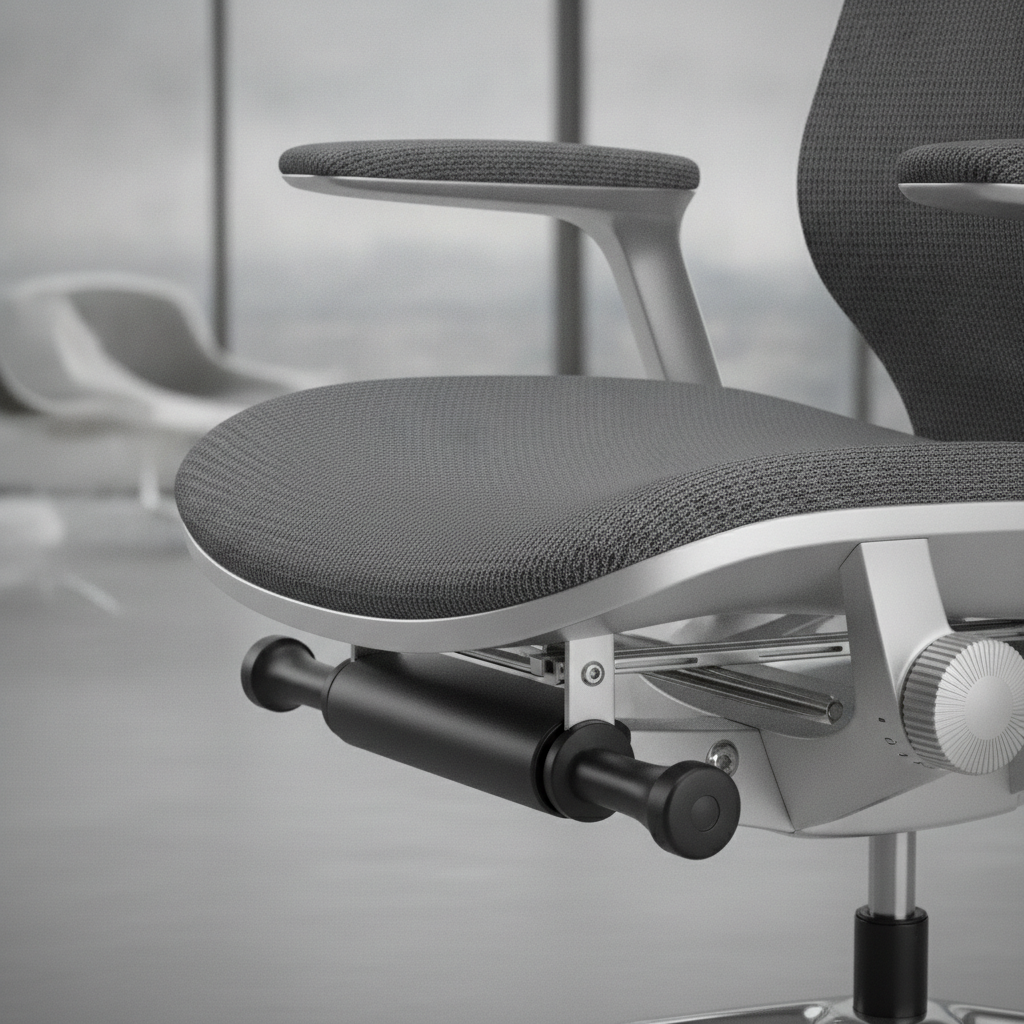
Sitting in a chair that doesn’t fit your body can cause pain and discomfort. One of the most important settings on your office chair is the seat depth. This guide will show you how to make a proper chair seat depth adjustment so you can sit comfortably all day. Whether you work from home or at an office, getting this right makes a big difference.
Quick Answer: The 3-Finger Rule for Chair Seat Depth Adjustment
If you want a fast answer, here it is. The 3-finger rule is the easiest way to check your chair seat depth adjustment. Sit all the way back in your chair. Then place your hand between the edge of the seat and the back of your knee. You should fit about two to three fingers in that gap. If you can’t fit any fingers, the seat is too long. If you can fit your whole hand, the seat is too short.
The Golden Rule: 2-3 Fingers of Knee Clearance
This rule is simple but very effective. When you sit with your back against the chair back, the front edge of the seat should not press into the back of your knees. There should be a small gap. That gap should be about 2 to 3 finger widths wide. This chair seat depth adjustment rule works for almost everyone. It helps keep blood flowing to your legs. It also stops pressure on the back of your knees.
Why Seat Depth Adjustment Matters for Comfort
A good chair seat depth adjustment affects how you feel after a long day at your desk. If the seat is too deep, it pushes against your knees. This can cause numbness and leg pain. If the seat is too shallow, your thighs don’t get enough support. This puts more pressure on your bottom and lower back. Both problems can lead to bad posture and pain over time.
Signs Your Seat Depth Needs Immediate Adjustment
Watch for these warning signs that your chair seat depth adjustment needs attention:
- Numbness or tingling in your legs after sitting
- Pressure marks on the back of your knees
- Your thighs don’t fully touch the seat
- You keep sliding forward in your chair
- Lower back pain that gets worse through the day
- You feel the need to shift positions constantly
Understanding Chair Seat Depth: Why Proper Adjustment Prevents Pain
Before you start your chair seat depth adjustment, it helps to understand why it matters. The seat depth is the distance from the front edge of the seat to the back of the chair. This measurement controls how much of your thigh the seat supports. Getting this right is a key part of good ergonomics.
What Is Seat Depth and How It Affects Your Body
Seat depth is the horizontal length of the chair seat from front to back. When you sit, your thighs should rest on the seat. The seat should support most of your thigh without touching the back of your knee. A correct chair seat depth adjustment spreads your body weight across a larger area. This reduces pressure points and keeps your blood moving.
Common Problems From Incorrect Seat Depth Adjustment
When you skip chair seat depth adjustment, several problems can happen:
- Seat too deep: The edge presses on your knees. Blood flow to your lower legs slows down. Your legs may feel numb or tingly.
- Seat too shallow: Only part of your thigh gets support. Pressure builds on your sit bones. Your lower back works harder to keep you upright.
- Both cases: You may lean forward or slouch. This leads to back, neck, and shoulder pain.
The Science: How Seat Depth Impacts Circulation and Posture
Research shows that the back of your knee has many blood vessels and nerves. When a chair seat presses against this area, it can slow blood flow. This is why proper chair seat depth adjustment is important for your health. Good seat depth also helps your pelvis stay in a neutral position. A neutral pelvis supports the natural curve of your lower back. This means less strain on your spine and muscles.
Who Needs Seat Depth Adjustment Most?
Certain people benefit more from chair seat depth adjustment than others:
- Very tall or very short people
- People who sit for more than 4 hours a day
- People with back or leg pain
- People who share a chair with someone else
- Office workers and remote workers
How to Measure Yourself for Correct Chair Seat Depth
Before you make any chair seat depth adjustment, you need to know your ideal seat depth. There are two easy ways to find this number. You can measure your body directly, or you can use your height to estimate it.
Step-by-Step: Measuring Buttock-to-Knee Length
This is the most accurate way to find your ideal seat depth.
- Sit on a hard, flat surface like a bench or the floor.
- Sit with your back straight and your knees bent at 90 degrees.
- Ask a friend to help you, or use a wall behind you.
- Measure from the back of your buttocks to the back of your knee (the popliteal fold).
- Write down this number in inches or centimeters.
- Subtract about 2 inches (5 cm) from this measurement. This gives you your ideal seat depth.
For example, if your buttock-to-knee length is 18 inches, your ideal seat depth is about 16 inches. This 2-inch gap gives room for the knee clearance you need.
Using Your Height to Estimate Ideal Seat Depth
If you don’t have a measuring tape, you can use your height as a guide. This method is less exact but still helpful for chair seat depth adjustment.
| Your Height | Estimated Seat Depth |
|---|---|
| Under 5’2″ (157 cm) | 14–15 inches (35–38 cm) |
| 5’2″–5’6″ (157–168 cm) | 15–16 inches (38–41 cm) |
| 5’7″–5’11” (170–180 cm) | 16–17 inches (41–43 cm) |
| 6’0″–6’3″ (183–191 cm) | 17–18 inches (43–46 cm) |
| Over 6’4″ (193 cm) | 18–20 inches (46–51 cm) |
Seat Depth Measurement Chart by Height
Here is a quick chart to help with your chair seat depth adjustment. Find your height range and use the suggested seat depth as a starting point. Then fine-tune using the 3-finger rule.
| Height Range | Seat Depth Range | Knee Clearance |
|---|---|---|
| 4’10″–5’2″ | 14″–15″ | 2–3 fingers |
| 5’3″–5’6″ | 15″–16″ | 2–3 fingers |
| 5’7″–5’10” | 16″–17″ | 2–3 fingers |
| 5’11″–6’2″ | 17″–18″ | 2–3 fingers |
| 6’3″ and above | 18″–20″ | 2–3 fingers |
Chair Seat Depth Adjustment: Step-by-Step Instructions by Mechanism Type
Not all chairs adjust the same way. The chair seat depth adjustment method depends on the type of mechanism your chair uses. Below are instructions for the most common types.
How to Adjust Seat Depth on Lever-Operated Chairs
Many modern office chairs use a lever for chair seat depth adjustment.
- Sit in the chair or stand beside it.
- Find the seat depth lever. It is usually on the left or right side under the seat.
- Pull the lever up or push it in to unlock the seat.
- Slide the seat forward or backward to your desired position.
- Release the lever to lock the seat in place.
- Test the position using the 3-finger rule.
How to Adjust Seat Depth on Knob-Release Chairs
Some chairs use a round knob for chair seat depth adjustment.
- Locate the knob under the front of the seat. It may be on the left or right side.
- Turn the knob counterclockwise to loosen it.
- Slide the seat pan forward or backward.
- Once the seat is in the right position, turn the knob clockwise to tighten it.
- Make sure the seat is locked and does not move when you push it.
How to Adjust Seat Depth on Sliding Seat Mechanisms
Some chairs have a seat that slides on rails without a lever.
- Stand beside the chair and face the seat.
- Grab the front edge of the seat with both hands.
- Pull the seat toward you or push it away firmly but smoothly.
- The seat should click into place at set positions.
- Check that the seat is locked by trying to move it again.
- Use the 3-finger rule to confirm the chair seat depth adjustment is correct.
How to Adjust Seat Depth on Pin-Lock Chairs
Pin-lock chairs use a metal pin that fits into holes to set the seat depth.
- Find the pin-release button or handle under the seat.
- Pull the pin out of the current hole.
- Slide the seat to the next hole that matches your measurement.
- Push the pin back in until it clicks.
- Tug the seat to make sure the pin is fully locked.
Brand-Specific Adjustment Tips (Herman Miller, HON, Steelcase)
Here are chair seat depth adjustment tips for popular brands:
- Herman Miller Aeron: The Aeron uses a pad adjustment knob on the back of the chair. Turn it to move the seat pad forward or backward. No sliding seat needed.
- HON Chairs: Most HON chairs have a lever on the left side under the seat. Pull it up, slide the seat, and release.
- Steelcase Leap and Gesture: These chairs have a slider on the left side. Pull the slider up, move the seat, and let go to lock it.
How to Verify Your Chair Seat Depth Adjustment Is Correct
After you make your chair seat depth adjustment, you need to check that it’s right. Here are four simple tests.
The 3-Finger Test: Checking Knee Clearance
Sit all the way back in your chair. Place your fingers flat between the seat edge and the back of your knee. You should fit 2 to 3 fingers. If you can only fit 1 finger, slide the seat forward. If you can fit 4 or more fingers, slide the seat back. This is the fastest way to verify your chair seat depth adjustment.
The Fist Test: Alternative Clearance Measurement
If you prefer a bigger gap, try the fist test. Make a loose fist and place it between the seat edge and your knee. Your fist should fit snugly. This gives about 3 to 4 inches of clearance. Some people like this extra space for better leg movement.
Thigh Support Check: Ensuring Even Weight Distribution
Run your hand under your thighs while sitting. You should feel the seat supporting your thighs all the way from your hips to about 2 inches before your knees. If there is a big gap under your thighs, the seat is too short. If the seat digs into your knees, it is too long. A good chair seat depth adjustment gives even support.
Posture Validation: Back Against Backrest Test
Sit with your back fully against the backrest. Your feet should be flat on the floor. Your knees should bend at about 90 degrees. Your thighs should be mostly supported by the seat. If you have to lean forward to avoid knee pressure, your chair seat depth adjustment needs more work. Slide the seat forward a little and try again.
Troubleshooting Common Chair Seat Depth Adjustment Problems
Sometimes things don’t go smoothly. Here are solutions to common chair seat depth adjustment problems.
What to Do When the Adjustment Lever Is Stuck
If the lever won’t move, try these steps:
- Stand up so there is no weight on the seat.
- Apply a small amount of lubricant like WD-40 to the lever mechanism.
- Wait 5 minutes for the lubricant to work.
- Try pulling the lever again gently.
- If it still won’t move, check for debris blocking the mechanism.
- Contact the chair manufacturer if nothing works.
Fixing Uneven Seat Sliding on One Side
If the seat slides more on one side, the rails may be dirty or bent.
- Turn the chair upside down on a soft surface.
- Check the rails for dirt or objects blocking the track.
- Clean the rails with a cloth.
- Apply a thin layer of silicone lubricant to both rails.
- Test the slide again.
What If Your Chair Has Insufficient Seat Depth Range?
Some chairs only offer 2 to 3 inches of adjustment. If this is not enough for a proper chair seat depth adjustment, you have a few options:
- Add a lumbar cushion to push your body forward, effectively reducing the seat depth.
- Use a seat cushion on the front edge to shorten the effective seat depth.
- Consider upgrading to a chair with a wider seat depth range.
Solutions for Chairs Without Seat Depth Adjustment
Not all chairs have this feature. If your chair doesn’t allow chair seat depth adjustment, try these workarounds:
- Use a back cushion to reduce the effective seat depth.
- Place a firm cushion behind your lower back to push you forward.
- If the seat is too deep, add a wedge cushion to tilt the seat and relieve knee pressure.
- For a seat that is too short, use a seat extender pad if available.
Integrating Seat Depth Adjustment With Other Ergonomic Settings
Chair seat depth adjustment does not work alone. It affects and is affected by other chair settings. Here’s how to coordinate them.
Adjusting Seat Height After Changing Seat Depth
When you change your seat depth, your sitting position may shift. After every chair seat depth adjustment, check your seat height. Your feet should still be flat on the floor. Your knees should still bend at about 90 degrees. Raise or lower the seat as needed.
Coordinating Lumbar Support With Seat Depth
The lumbar support should fit into the natural curve of your lower back. When you change seat depth, the position of your back relative to the lumbar support changes. After your chair seat depth adjustment, move the lumbar support up or down so it sits right at your lower back curve.
Armrest Position and Seat Depth Relationship
If you slide the seat forward, your body moves closer to your desk. This may require you to raise or lower your armrests. After chair seat depth adjustment, check that your arms rest comfortably on the armrests. Your elbows should bend at about 90 degrees. Your shoulders should stay relaxed.
Complete Ergonomic Chair Adjustment Checklist
Use this checklist after your chair seat depth adjustment to make sure everything is set correctly:
- Seat depth: 2-3 fingers between seat edge and knee
- Seat height: Feet flat on floor, knees at 90 degrees
- Backrest angle: Slightly reclined, about 100-110 degrees
- Lumbar support: Fills the curve of your lower back
- Armrests: Elbows at 90 degrees, shoulders relaxed
- Monitor height: Top of screen at or slightly below eye level
- Keyboard position: Close enough that elbows stay at your sides
FAQ: Common Questions About Chair Seat Depth Adjustment
How Often Should You Adjust Seat Depth?
You should check your chair seat depth adjustment when you first set up your chair. After that, check it every few months. If you share the chair with someone else, adjust it each time a different person uses it. Also readjust if you feel new discomfort or numbness in your legs.
Can Seat Depth Adjustment Fix Lower Back Pain?
Chair seat depth adjustment can help reduce lower back pain, but it may not fix it completely. A correct seat depth supports your thighs and keeps your pelvis in a good position. This takes some pressure off your lower back. However, if your back pain is severe, see a doctor. You may also need to adjust other settings like lumbar support and seat height.
What Is the Ideal Seat Depth for Tall People?
Tall people (over 6 feet) usually need a seat depth of 17 to 20 inches. The exact number depends on your leg length. Use the buttock-to-knee measurement method to find your ideal number. Then subtract 2 inches for knee clearance. Many standard chairs don’t go deep enough for very tall people. In that case, look for chairs designed for tall users.
Do Gaming Chairs Need Seat Depth Adjustment?
Yes, gaming chairs benefit from chair seat depth adjustment just like office chairs. However, many gaming chairs have a fixed seat depth. If your gaming chair has an adjustable seat, use the same 3-finger rule. If it doesn’t adjust, try using a lumbar pillow to change your sitting position.
Is Seat Depth Adjustment Worth It on Budget Chairs?
Even on budget chairs, chair seat depth adjustment can make a big difference in comfort. If your budget chair has this feature, use it. If it doesn’t, you can still improve your fit with cushions and pillows. However, if you sit for many hours each day, investing in a chair with full adjustment features is worth it in the long run.
Conclusion: Your Chair Seat Depth Adjustment Action Plan
Now you have everything you need to make a proper chair seat depth adjustment. Here is your action plan:
- Measure yourself: Use the buttock-to-knee method or the height chart to find your ideal seat depth.
- Adjust your chair: Follow the steps for your chair’s mechanism type to set the seat depth.
- Test with the 3-finger rule: Make sure you have 2-3 fingers of knee clearance.
- Check other settings: Adjust seat height, lumbar support, and armrests to match.
- Sit and feel: Spend 10 minutes in the chair. Make small changes if needed.
- Recheck monthly: Your body and needs can change. Review your chair seat depth adjustment every few months.
A good chair seat depth adjustment takes only a few minutes but can save you from hours of pain and discomfort. Take the time to get it right. Your back, legs, and overall health will thank you. Start adjusting your chair today and enjoy a more comfortable workday tomorrow.