

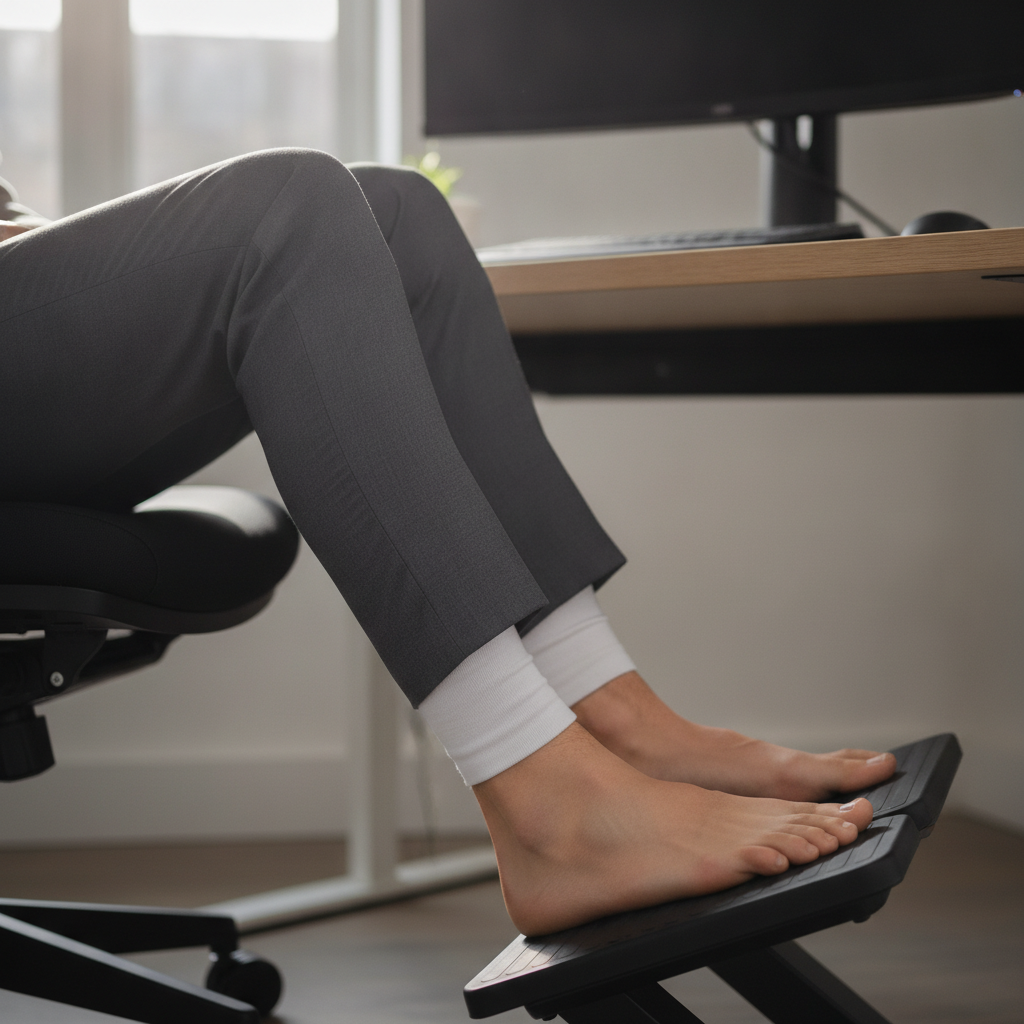
Sitting at a desk all day can hurt your body if you do not set things up right. Many people focus on their chair or monitor but forget about their feet. Proper foot placement at a desk is the base of good posture. When your feet are in the right position, your whole body feels better. This guide will show you exactly how to place your feet at a desk for comfort and health. It works for students, office workers, and anyone who spends time at a desk.
Before you start, you will need a few things. Make sure you have an adjustable chair, a desk at the right height, and a flat floor space under your desk. If your feet do not reach the floor, you will also need a footrest. A small ruler or tape measure can help you check heights. Now let us begin.
Why Proper Foot Placement at a Desk Matters
Your feet support your entire body when you sit. If they are not in the right spot, problems start from the ground up. Good foot placement at a desk keeps your spine aligned and reduces stress on your muscles and joints. It is the first thing you should check when setting up your workspace.
The Connection Between Foot Placement and Full-Body Posture
Your body works as one unit. When your feet are flat on the floor, your hips stay level. Level hips keep your spine in a natural curve. This means your back, neck, and shoulders do not have to work extra hard. Poor foot placement at a desk breaks this chain. Your pelvis tilts, your spine curves the wrong way, and pain follows. Think of your body like a stack of blocks. If the bottom block is off, the whole stack falls.
Common Problems Caused by Poor Foot Positioning at a Desk
When foot placement at a desk is wrong, you may notice these issues:
- Lower back pain from uneven hip pressure
- Numbness or tingling in your legs and feet
- Swelling in your ankles after long sitting sessions
- Neck and shoulder tension from poor spinal alignment
- Knee pain from dangling or crossed legs
- General tiredness and lack of focus during work
These problems get worse over time. Fixing your foot placement at a desk can stop them before they become serious.
Step-by-Step Foot Placement at a Desk Guide for Seated Work
This section is the core of the guide. Follow each step in order for the best results. Take your time and check each point carefully.
Step 1: Adjust Chair Height for Proper Foot Placement
Start by sitting in your chair. Let your arms hang loose at your sides. Now slide your chair up or down until your feet rest flat on the floor. Your knees should bend at about a 90-degree angle. If your feet dangle, your chair is too high. If your knees are way above your hips, your chair is too low. This step is the most important part of foot placement at a desk. Get it right before moving on.
Step 2: Check Knee and Hip Alignment at Your Desk
With your chair at the right height, check your legs. Your knees should be at the same level as your hips or slightly below. There should be a small gap between the edge of the seat and the back of your knees. About two to three fingers of space is perfect. This gap stops pressure on your legs and helps blood flow. Proper knee and hip alignment is key to good foot placement at a desk.
Step 3: Position Feet Flat and Supported on the Floor
Place both feet flat on the floor. They should be about shoulder-width apart. Do not tuck one foot under your chair. Do not point your toes way out. Your feet should face forward or turn out just a little. Your weight should be even on both feet. If the floor is hard or cold, a thin mat can help. This is the ideal foot placement at a desk for most people.
Step 4: Verify Thigh Clearance and Comfort
Finally, check the space under your desk. Your thighs should fit comfortably without hitting the desk surface. There should be no pressure on the top of your legs. If the desk is too low, you may need to raise it or use a footrest. Take a moment to sit still and feel for any tight spots. Good foot placement at a desk means your whole lower body feels relaxed.
How to Use a Footrest for Proper Foot Placement at a Desk
Sometimes your chair cannot go low enough. Or your desk is too high to change. In these cases, a footrest solves the problem. A footrest brings the floor up to your feet. This makes proper foot placement at a desk possible for almost everyone.
When You Need a Footrest for Desk Foot Placement
You need a footrest if any of these are true:
- Your feet do not touch the floor when your chair is at desk height
- You are shorter than average height (under 5 feet 4 inches)
- Your desk cannot be lowered to the right level
- You feel pressure behind your knees from the chair edge
Choosing the Right Footrest Height and Angle
A good footrest should let your knees stay at a 90-degree angle. The height should bring your feet up so your thighs are parallel to the floor. Some footrests have an adjustable angle. A slight tilt of about 10 to 15 degrees is best. This angle matches the natural slope of your feet. Look for a footrest that is at least as wide as your shoulders. It should also have a non-slip surface for safety.
Footrest vs. Foot Rail: Which Is Better for Desk Work?
A footrest is a flat platform that holds both feet. A foot rail is a bar you can rest one foot on. For foot placement at a desk, a flat footrest is usually better. It supports both feet equally and keeps your hips level. A foot rail can work if you switch feet often. But it may cause uneven hip height over time. For most desk workers, a solid footrest is the smarter choice.
Foot Placement at a Standing Desk Guide
Standing desks are popular now. But standing all day has its own foot placement rules. Bad standing habits can cause just as many problems as bad sitting ones.
Ideal Stance Width and Weight Distribution at a Standing Desk
Stand with your feet about shoulder-width apart. Keep your weight even on both feet. Do not lean to one side. Your feet should point straight ahead. Lock your knees softly, not all the way back. This stance gives you a strong base. It also helps good foot placement at a desk while you stand. Shift your weight slightly every few minutes to stay comfortable.
Using Anti-Fatigue Mats for Better Foot Placement
An anti-fatigue mat is a soft pad you stand on. It reduces pressure on your feet and legs. The cushioning encourages small foot movements. These movements improve blood flow and reduce tiredness. Place the mat right in front of your standing desk. Make sure it does not slide. A good mat is one of the best tools for foot placement at a desk when standing.
Transitioning Between Sitting and Standing at Your Desk
Do not stand all day or sit all day. Switch between the two. A common rule is to stand for 15 to 30 minutes every hour. When you switch, reset your foot placement at a desk each time. Check that your feet are flat, your knees are bent right, and your weight is even. This habit keeps your body balanced throughout the day.
Foot Placement at a Desk Guide for Different Body Types
Not everyone is the same size. Your body type changes what good foot placement at a desk looks like. Here are adjustments for different needs.
Foot Placement Adjustments for Shorter Users
If you are shorter, your chair may need to go higher to reach the desk. This can leave your feet hanging. Use a footrest to fix this. Set the footrest so your knees are at 90 degrees. You may also need a smaller footrest that fits your shorter legs. Proper foot placement at a desk is very important for shorter users to avoid leg pain.
Foot Placement Adjustments for Taller Users
Taller users often have the opposite problem. Their knees may be too high. Lower your chair until your feet are flat. If the desk is then too low, raise the desk or use keyboard tray. Make sure there is enough thigh clearance. Taller users need extra space under the desk for good foot placement at a desk.
Accessibility Considerations for Foot Placement at a Desk
Some people have conditions that affect their feet or legs. If you use a wheelchair, make sure your feet are supported on footrests. The angle should keep your hips and knees comfortable. If you have limited feeling in your feet, check your foot position often. Use cushions or supports as needed. Good foot placement at a desk is possible for everyone with the right tools.
Troubleshooting Common Foot Placement Problems at a Desk
Even with a good setup, problems can come up. Here is how to fix the most common ones.
Fixing Numbness or Tingling in Feet and Legs
Numbness usually means pressure on a nerve or poor blood flow. Check if the chair edge presses into your thighs. Move forward slightly to create a gap. Make sure your feet are flat and not crossed. Stand up and walk for a minute. If the numbness keeps coming back, your foot placement at a desk needs more adjustment.
Relieving Pressure Behind the Knees at Your Desk
Pressure behind the knees happens when the seat is too deep or too low. Raise your chair a little. Check that there is a two-to-three-finger gap between the seat edge and your knees. A footrest can also help by changing the angle of your legs. This simple fix improves foot placement at a desk fast.
Addressing Hip or Lower Back Discomfort from Foot Position
If your hips or back hurt, your feet are probably not flat. One foot may be tucked or crossed. Uncross your legs. Put both feet flat on the floor. Sit back in your chair so your lower back is supported. If pain continues, check your chair height again. Proper foot placement at a desk often solves back pain quickly.
How to Stop Crossing Legs or Tucking Feet at a Desk
Crossing legs feels good for a short time but causes problems later. To break this habit, make sure your chair height is right. If your feet are flat and supported, you will not want to cross them. A footrest can also help by giving your feet a comfortable place to rest. Set a timer to remind yourself to uncross every 20 minutes. Over time, good foot placement at a desk becomes natural.
How to Maintain Good Foot Placement at a Desk Throughout the Day
Setting up your feet once is not enough. You need to keep good foot placement at a desk all day long.
Movement Breaks and Position Variation for Desk Foot Placement
Stay still for too long and your body gets stiff. Get up every 30 to 60 minutes. Walk around for two to three minutes. Stretch your legs and ankles. When you sit back down, reset your foot placement at a desk. Small movements keep your muscles active and your joints healthy.
Footwear Considerations for Proper Foot Placement at a Desk
What you wear on your feet matters. Flat shoes with good support are best. High heels change your foot angle and hurt your posture. Very flat shoes with no support can also cause problems. Some people like to work in clean socks or bare feet. This is fine if the floor is warm and clean. The key is that your feet feel supported for good foot placement at a desk.
Self-Assessment Checklist for Foot Placement at a Desk
Use this quick checklist to check your setup:
| Check Point | Yes or No |
|---|---|
| Are both feet flat on the floor or footrest? | |
| Are your knees at about 90 degrees? | |
| Is there a gap behind your knees? | |
| Are your feet shoulder-width apart? | |
| Do your thighs fit under the desk? | |
| Are your hips level and comfortable? |
If you answered “no” to any of these, go back and fix your foot placement at a desk.
FAQ: Common Questions About Foot Placement at a Desk
Should My Feet Always Be Flat on the Floor at a Desk?
Yes, in most cases. Flat feet give you the best support and balance. If your chair is at the right height but your feet cannot reach the floor, use a footrest. The goal of foot placement at a desk is to have both feet fully supported, whether on the floor or on a rest.
How Do I Know If My Foot Placement at a Desk Is Correct?
You will feel it. Your legs should feel relaxed. Your feet should not tingle or go numb. Your lower back should not hurt after sitting. Use the checklist above to test your setup. If everything checks out, your foot placement at a desk is good.
Can Poor Foot Placement at a Desk Cause Back Pain?
Yes, it can. When your feet are not flat, your hips tilt. A tilted hip pulls your spine out of alignment. This puts stress on your lower back. Over time, this leads to pain. Fixing your foot placement at a desk is often the first step to stopping back pain.
Final Tips for Comfortable Foot Placement at a Desk
Good foot placement at a desk is simple but powerful. Keep your feet flat, your knees at 90 degrees, and your hips level. Use a footrest if you need one. Move often and check your setup throughout the day. These small steps make a big difference in how you feel. Start today by adjusting your chair and checking your feet. Your body will thank you tomorrow.
Remember, the best foot placement at a desk is one you can keep all day without pain. Take a few minutes now to set it up right. Then enjoy your work with comfort and focus.