

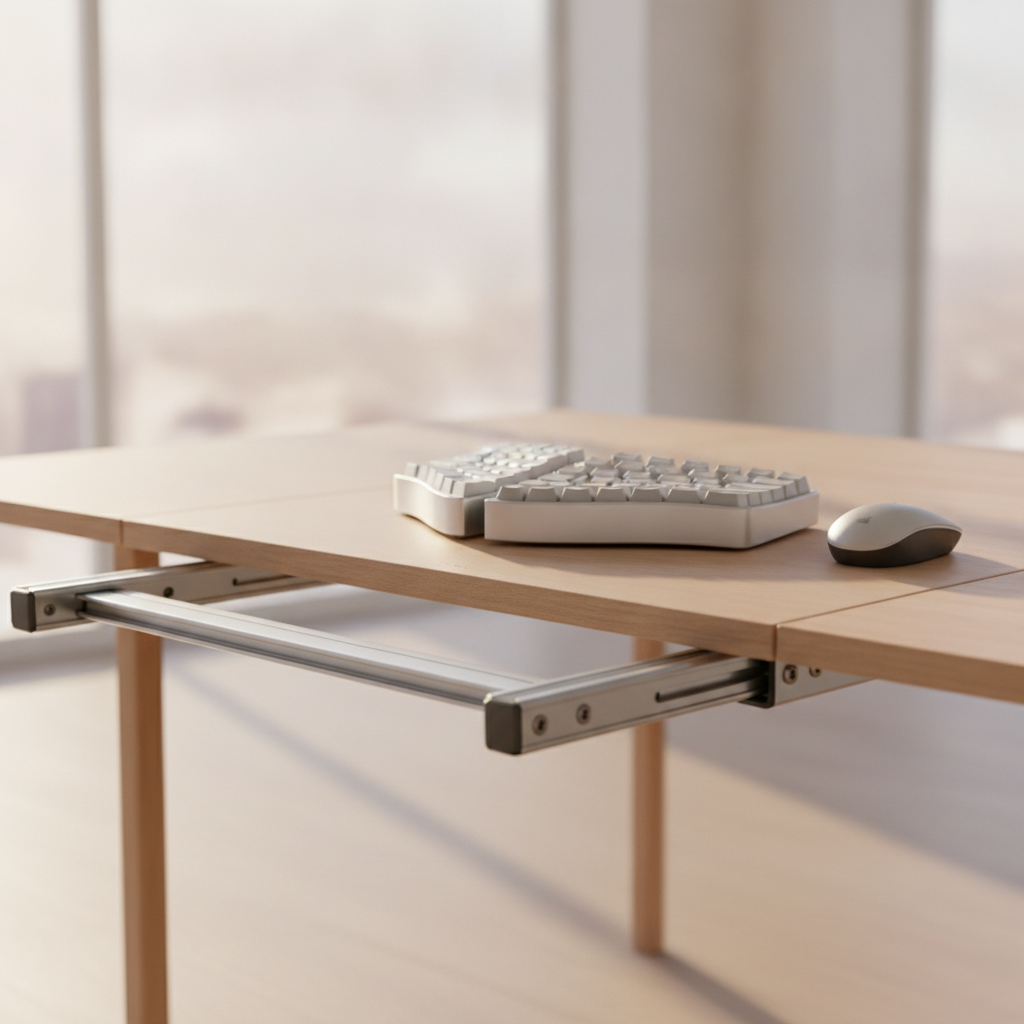
Choosing the right keyboard tray depth is important for comfort and health. A wrong depth can cause wrist pain, shoulder strain, and bad posture. This guide shows you exactly how to pick the best keyboard tray depth for your desk setup. You will learn to measure, compare, and choose with confidence.
Quick Answer: What Is the Ideal Keyboard Tray Depth?
The ideal keyboard tray depth depends on your keyboard type and what else you place on the tray. For most users, a keyboard tray depth between 10 and 12 inches works well. This gives enough room for your keyboard, mouse, and wrist rest.
Minimum Depth for Common Keyboard Types
| Keyboard Type | Minimum Keyboard Tray Depth |
|---|---|
| 60% Compact | 8 inches |
| Tenkeyless (TKL) | 9 inches |
| Full-Size | 10 inches |
| Ergonomic Split | 11 inches |
The 10-Inch Rule for Keyboard Tray Depth
The 10-inch rule is a simple guide. Most full-size keyboards are about 7 to 8 inches deep. Adding 2 to 3 inches for mouse space gives you a keyboard tray depth of 10 inches. This rule fits most home and office setups.
Why One Size Does Not Fit All
People use different keyboards, mice, and desk sizes. Your keyboard tray depth must match your tools and body. A tray that is too small feels cramped. A tray that is too big wastes space and may not fit under your desk.
What Does Keyboard Tray Depth Mean? Understanding the Key Measurements
Keyboard tray depth means the front-to-back distance of the tray platform. This is the space where your keyboard and mouse sit. Understanding this helps you choose the right keyboard tray depth for your needs.
Usable Platform Depth vs. Overall Product Depth
Usable platform depth is the flat area where you place items. Overall product depth includes lips, edges, and mounting parts. Always check the usable keyboard tray depth, not the total size.
Mounting Depth and Track Length Explained
Mounting depth is how far the tray slides under the desk. Track length is the rail that holds the tray. These affect how far the keyboard tray depth reaches toward you when pulled out.
Keyboard Tray Depth vs. Width: What’s the Difference?
Depth is front to back. Width is left to right. Many buyers mix these up. The keyboard tray depth affects your arm reach. The width affects how many items fit side by side.
How to Measure for Keyboard Tray Depth: Step-by-Step Process
Follow these steps to find the right keyboard tray depth for your setup. You need a tape measure, paper, and pen.
Step 1: Measure Your Keyboard Depth (Front to Back)
Place your keyboard flat. Measure from the front edge to the back edge. Write down the number. Most full-size keyboards are 7 to 8 inches deep. Compact ones are 4 to 5 inches.
Step 2: Measure Your Mouse and Wrist Rest Space
Measure your mouse pad or mouse area. Add 3 to 4 inches for mouse movement. If you use a wrist rest, add its depth too. A typical wrist rest is 2 to 3 inches deep.
Step 3: Measure Available Under-Desk Depth
Measure the space under your desk from front to back. This is the max keyboard tray depth you can use. Make sure the tray fits without hitting the wall or desk legs.
Step 4: Check for Obstructions (Drawers, Crossbars, Cable Trays)
Look under your desk. Check for drawers, support bars, or cable trays. These reduce the usable keyboard tray depth. Measure around them to find clear space.
Step 5: Calculate Your Required Keyboard Tray Depth
Add these numbers together:
- Keyboard depth
- Mouse space (3-4 inches)
- Wrist rest depth (if used)
- Buffer space (1-2 inches)
This total is your needed keyboard tray depth.
Recommended Keyboard Tray Depth by Setup Type
Different setups need different keyboard tray depth. Here are clear guides for each type.
Compact and 60% Keyboards: Minimum 8–9 Inches
Compact keyboards are small. A keyboard tray depth of 8 to 9 inches gives room for the keyboard and mouse. This is good for small desks.
Tenkeyless (TKL) Keyboards: Minimum 9–10 Inches
TKL keyboards lack the number pad. They are about 6 inches deep. A keyboard tray depth of 9 to 10 inches works best with mouse space.
Full-Size Keyboards with Number Pad: Minimum 10–11 Inches
Full-size keyboards are 7 to 8 inches deep. You need a keyboard tray depth of 10 to 11 inches to fit the keyboard, mouse, and a small wrist rest.
Ergonomic and Split Keyboards: Minimum 10–12 Inches
Ergonomic keyboards are wider and sometimes deeper. A keyboard tray depth of 10 to 12 inches gives enough room for the split design and mouse.
Keyboard Plus Mouse Plus Wrist Rest: Minimum 11–13 Inches
If you use all three, you need more space. A keyboard tray depth of 11 to 13 inches keeps everything comfortable and within easy reach.
How Much Extra Clearance Should You Add to Keyboard Tray Depth?
Adding extra space makes your setup more comfortable. Here is how much to add.
The 1–2 Inch Buffer Rule for Comfort
Add 1 to 2 inches beyond your basic needs. This buffer gives room for small movements and prevents a tight feel. It is the key to a good keyboard tray depth.
Accounting for Wrist Rests and Palm Support
Wrist rests add 2 to 3 inches. If you use one, include its depth in your keyboard tray depth calculation. This keeps your wrists supported.
Space for Mouse Movement and Cable Connectors
Mice need room to move. Cables need space to bend. Add 3 to 4 inches for the mouse and 1 inch for cables when planning your keyboard tray depth.
Tray Lip and Edge Clearance Considerations
Some trays have a front lip to stop items sliding off. This lip takes up space. Subtract its size from your usable keyboard tray depth.
How to Check Mounting Hardware Compatibility for Keyboard Tray Depth
Your desk must support the keyboard tray depth you want. Check these factors before buying.
Track Length vs. Keyboard Tray Depth Requirements
The track must be long enough to hold your tray. If your keyboard tray depth is 12 inches, the track should be at least that long. Short tracks limit your options.
Desk Thickness and Clamp-On Mount Limits
Clamp-on mounts work on desks 1 to 3 inches thick. Measure your desk edge. If it is too thick or thin, the mount may not fit your keyboard tray depth setup.
Screw-Mount vs. Clamp-On: Which Works for Your Desk?
Screw-mount needs drilling. It is strong and fits most keyboard tray depth needs. Clamp-on is easy to install but may not hold very deep trays well.
Knee and Thigh Clearance at Different Tray Depths
Deeper trays sit closer to you. Make sure your knees have room. Sit in your chair and check. A good keyboard tray depth should not touch your legs.
Ergonomic Considerations When Choosing Keyboard Tray Depth
The right keyboard tray depth keeps your body healthy. Follow these tips for good posture.
Optimal Wrist and Shoulder Position Based on Depth
Your wrists should be straight. Your shoulders should be relaxed. The keyboard tray depth should let your arms hang naturally at your sides.
Negative Tilt and Its Relationship to Tray Depth
Negative tilt angles the tray away from you. This works best with a keyboard tray depth of 10 inches or more. It keeps your wrists flat and safe.
OSHA Guidelines for Keyboard Tray Fit
OSHA says your keyboard tray depth should let you type with elbows at 90 degrees. The tray should be close enough to avoid reaching. Follow these rules for safety.
How Keyboard Tray Depth Affects Typing Posture
Too shallow, and you reach forward. Too deep, and you pull back. The right keyboard tray depth keeps your back straight and arms relaxed.
Keyboard Tray Depth for Sit-Stand Desks: Special Considerations (2026)
Sit-stand desks need special thought for keyboard tray depth. The tray must work in both positions.
Mounting Stability at Different Desk Heights
Check that the mount stays tight when the desk moves. A stable mount supports your keyboard tray depth at any height.
Cable Slack and Tray Depth for Standing Use
When standing, cables stretch. Make sure your keyboard tray depth setup has enough cable length. Use cable managers to keep things tidy.
Best Keyboard Tray Depth for Adjustable Desks
For adjustable desks, choose a keyboard tray depth of 10 to 12 inches. This fits most keyboards and works well when sitting or standing.
Sit-Stand Desk Frame Interference Issues
Some desk frames block the tray. Measure the frame before buying. Your keyboard tray depth must clear any crossbars or supports.
Common Mistakes When Choosing Keyboard Tray Depth
Avoid these errors to pick the right keyboard tray depth.
Confusing Width and Depth in Product Specs
Width is left to right. Depth is front to back. Always check which number is the keyboard tray depth before buying.
Forgetting to Measure the Mouse Area
The mouse needs space too. If you only measure the keyboard, your keyboard tray depth will be too small.
Ignoring Under-Desk Obstructions
Drawers and bars block the tray. Measure under your desk first. Your keyboard tray depth must fit around these items.
Choosing Depth Without Checking Mounting Hardware
The mount must match your desk. Check the desk thickness and mount type. A good keyboard tray depth is useless if it does not fit.
Overlooking Wrist Rest and Ergonomic Needs
Wrist rests add depth. If you forget them, your keyboard tray depth will be too tight. Always include ergonomic items in your plan.
FAQ: Common Questions About How to Choose Keyboard Tray Depth
What Is the Standard Keyboard Tray Depth?
The standard keyboard tray depth is 10 to 11 inches. This fits most full-size keyboards and mice.
Can a Keyboard Tray Be Too Deep?
Yes. A tray that is too deep wastes space and may not fit under your desk. It can also push you too far from the desk edge.
How Do I Know If a Keyboard Tray Will Fit My Desk?
Measure your under-desk space. Compare it to the keyboard tray depth and mount size. Make sure both fit with room to spare.
Do Ergonomic Keyboards Need Deeper Trays?
Often yes. Ergonomic keyboards are wider and sometimes deeper. A keyboard tray depth of 11 to 12 inches works best for them.
What Depth Keyboard Tray Do I Need for a Full-Size Keyboard and Mouse?
You need a keyboard tray depth of at least 10 inches. Add 1 to 2 inches for comfort, so 11 to 12 inches is ideal.
Final Checklist: How to Choose the Right Keyboard Tray Depth
Use this checklist before you buy. It makes sure you pick the right keyboard tray depth.
Quick Measurement Formula for Keyboard Tray Depth
Use this simple formula:
Keyboard depth + Mouse space (3-4″) + Wrist rest (if used) + Buffer (1-2″) = Needed keyboard tray depth
Pre-Purchase Verification Checklist
- Measure your keyboard depth
- Measure your mouse area
- Check for wrist rest needs
- Measure under-desk space
- Check for obstructions
- Verify mount compatibility
- Test knee clearance
- Compare to product specs
Top 3 Keyboard Tray Depth Picks by Setup Type (2026)
| Setup Type | Recommended Keyboard Tray Depth | Best For |
|---|---|---|
| Compact Setup | 8-9 inches | Small desks, 60% keyboards |
| Standard Office | 10-11 inches | Full-size keyboards, home office |
| Ergonomic Pro | 12-13 inches | Split keyboards, wrist rests, long sessions |
Now you know how to choose the right keyboard tray depth. Measure your space, match your tools, and pick a tray that fits your body. Good keyboard tray depth leads to comfort, health, and better work. Start measuring today and enjoy a better desk setup tomorrow.